In the 2d toric code, a loop that winds around the torus measures topological inforamtion in the background. A topologically ordered phase can be characterized by persistence of such background information over large distances and can be detected by correlated loop operators that are far apart. We used hcphases 0.8.0 to check much of that agreement survives magnetic fields and heating.
What is ordered in the toric code?
Put a qubit on each edge of a square lattice and join opposite sides to make a torus. A star operator \(A_v\) multiplies the four Pauli \(X\) operators incident on vertex \(v\). A plaquette operator \(B_f\) multiplies the four \(Z\) operators around face \(f\). The Hamiltonian rewards having both kinds of operator equal to \(+1\) and adds uniform fields of strength \(g\) and \(h\).
\[\begin{aligned}H={}&-\frac{J}{2}\sum_v(1+A_v)-\frac{K}{2}\sum_f(1+B_f)\\ &-g\sum_e X_e-h\sum_e Z_e.\end{aligned}\]
With the fields off, the torus has four ground states. They can be distinguished by operators that wind around the torus, while measurements on a small patch give the same answers in all four. This is a hallmark of topological order. Information is encoded across the system, which is why the code is a model for protecting quantum information against local disturbances. Other ways to diagnose the order include the universal contribution to entanglement entropy and the scaling of suitable loop observables with system size.
Wu, Deng and Prokof’ev used continuous-time Monte Carlo and finite-size scaling to map the ground-state phases. Two continuous boundaries enclose the weak-field topological region. Stronger fields favor condensation of charges on the \(Z\)-dominated side and vortices on the \(X\)-dominated side. A short first-order segment lies between those regimes along equal fields. Past its endpoint, the two polarizations can be connected by rotating the field. Ground-state phase diagram.
Measuring agreement around the torus
A Wilson loop \(W\) multiplies \(Z_e\) along a closed path. We chose two parallel paths that wind around the same direction, on the same time slice, separated by half the lattice width. That separation grows with \(L\) and is two lattice spacings on our \(4\times4\) torus. We measured the connected correlation
\[C_W=\langle W_1W_2\rangle-\langle W_1\rangle\langle W_2\rangle,\]
and averaged over the two winding directions. The subtraction asks how much the loops agree beyond their individual preferences. In the source-free ground-state ensemble, either loop can have sign \(+1\) or \(-1\) across the logical sectors, but the two have the same sign within a sector. The connected correlation is then one. A strong field can also make both loops agree by fixing their signs, in which case the subtraction leaves little connected signal. We track the average edge magnetizations \(m_X\) and \(m_Z\) alongside the loops to tell these cases apart.
We set \(J=K=1\) and sampled a classical spacetime representation of the quantum thermal state. The sampler sums eight winding sign shifts exactly and uses collective updates to explore the remaining configurations. Across 54 field and temperature settings, we ran two ordered and two random starts per setting. We checked how well histories agree with split \(\widehat R\), how many effective samples they contain, and how stable their block error estimates are. In the longer runs at the center, the magnetization and loop diagnostics gave \(\widehat R\) close to one and hundreds to thousands of effective samples, while every setting remained unresolved under the full convergence screen.
The continuation had a seven-hour budget on six CPU cores with about 16 GiB of memory. It went toward longer histories and denser coverage of the competing-field region. The resulting field scan stays at \(L=4\), with one imaginary-time discretization per temperature, leaving the large-system and continuum limits open. Simulation report and convergence results.
A familiar pattern at low temperature
At \(T=0.125\), the weak-field corner has strong loop agreement and little magnetization. Increasing either field brings up its corresponding magnetization and suppresses the connected loop signal. The map blends three color layers for the loop correlation and the two magnetizations. Circles mark sampled field settings, and shading beyond the sampled rectangle extrapolates from those measurements.
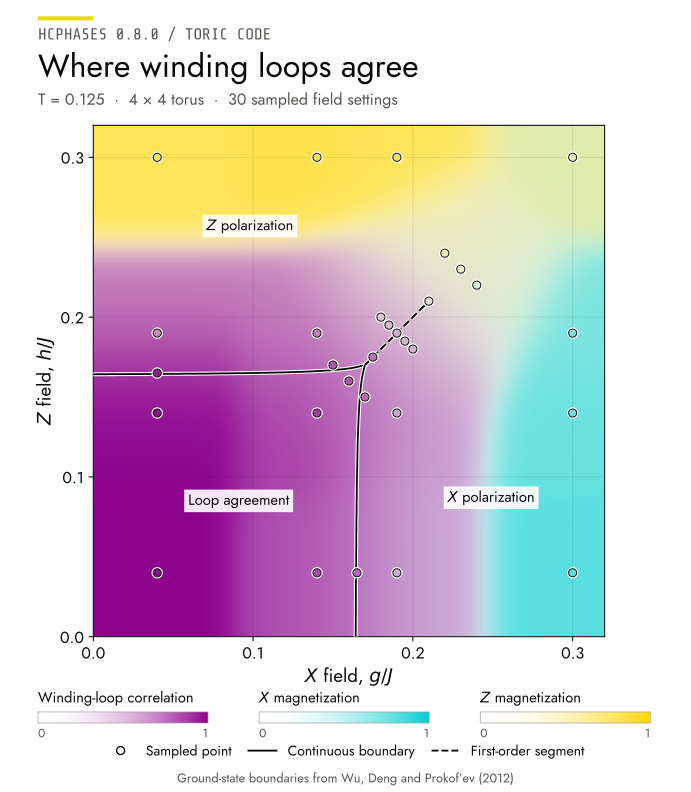
The overlaid lines come from Fig. 17 of Wu, Deng and Prokof’ev. In their normalization the stabilizer coefficients are one, so their fields are \(h_x=2g\) and \(h_z=2h\) for our \(J=K=1\). The solid lines bound the ground-state topological region and the dashed segment runs along \(g=h\) from about 0.170 to 0.209. The cold data recover the broad organization of the regions. The changes are rounded and extend across the reference lines, as the equal-field cut makes clear. Published phase boundaries, Fig. 17.
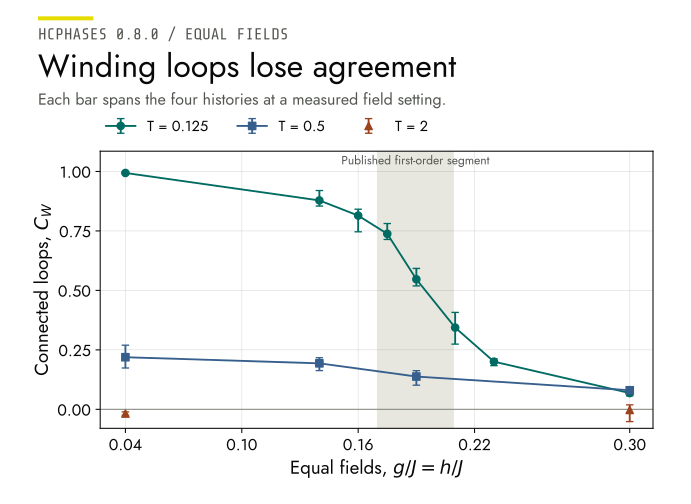
Along equal fields, the four-history mean of \(C_W\) falls from about 0.74 at \(g=h=0.175\) to 0.20 at \(g=h=0.23\). Bare loops can also lose signal as their circumference grows. We read this as a finite-size crossover, with the published critical lines and endpoints supplied by a separate scaling analysis.
What survives heating?
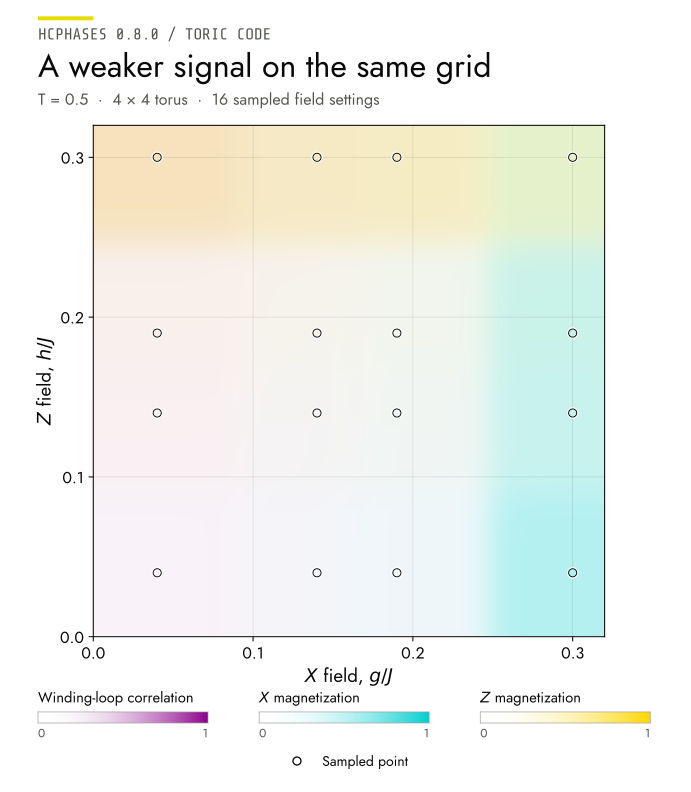
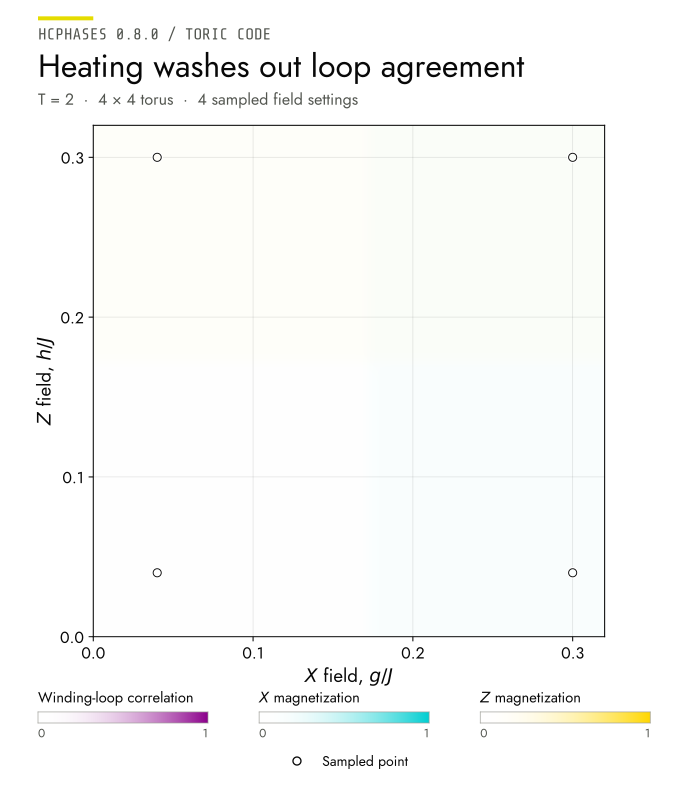
At \(g=h=0.04\), the mean loop correlation falls from about 0.994 at \(T=0.125\) to 0.219 at \(T=0.5\) and fluctuates near zero at \(T=2\). At the hottest temperature we sampled four corners. The same color scale shows how much the cold pattern has faded, with a weak response to the applied fields still visible. The hottest run used a coarser imaginary-time step.
The intermediate map at \(T=0.5\) revisits the 16 cold grid points at the same imaginary-time step. Reading it alongside the hotter map shows the progressive loss of loop agreement.
The long-range entanglement of the ground state is thermally fragile. Mazáč and Hamma showed that the source-free two-dimensional toric code loses its topological entropy at every positive temperature in the thermodynamic limit. Multiplying the plaquettes in the strip between the two winding loops cancels the interior edges and leaves the two boundary loops. Thermal defects randomize the strip’s parity, so at fixed positive temperature the source-free loop correlation tends to zero as the strip grows. The loss of loop agreement in our finite torus with fields is consistent with that thermal picture. Topological order at finite temperature.